

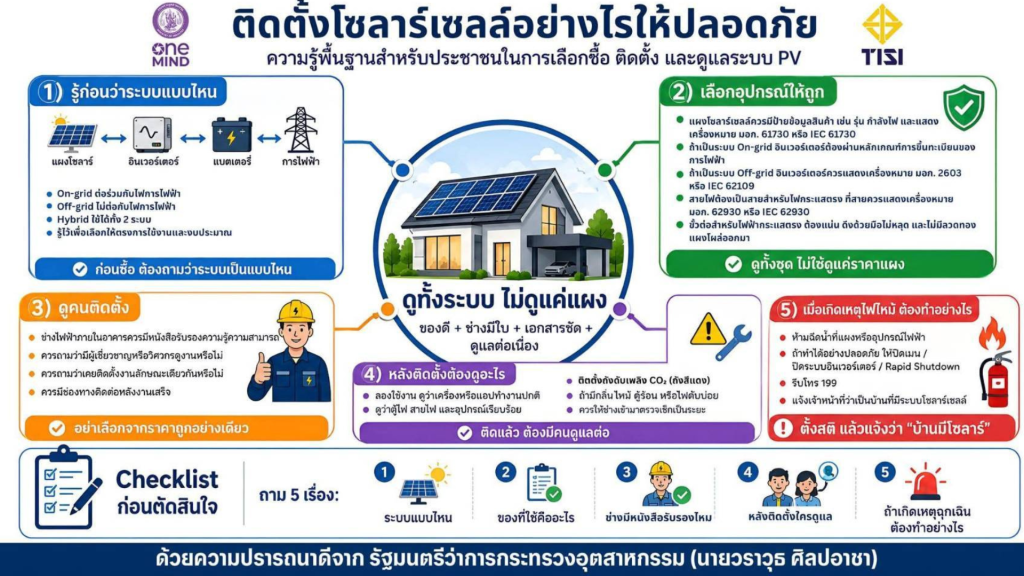
For public safety, the Ministry of Industry recommends the following essential guidelines for residential solar cell systems:
- Identify the System Type
Select a system that matches your budget and usage requirements:
On-Grid: Connected to the electrical grid.
Off-Grid: Standalone system independent of the grid.
Hybrid: Combines both on-grid and off-grid features. - Verify Equipment Standards
2.1) Solar Panels: Check the model, power output, and TIS 61730 or IEC 61730 certification.
2.2) On-Grid Inverter: Must be registered and approved by the relevant electricity authority.
2.3) Off-Grid Inverter: Should carry TIS 2603 or IEC 62109 certification.
2.4) DC Cables: Use DC-specific cables certified under TIS 62930 or IEC 62930.
2.5) DC Connectors: Must be securely locked (cannot be pulled apart by hand) with no exposed wiring. - Professional Installation
Hire experienced solar contractors who hold a professional “Certificate of Knowledge and Ability” (Indoor Electrician Level 1). Ensure they provide accessible after-sales service and ongoing support. - Post-Installation Maintenance
Regularly monitor system and app performance.
Routinely inspect the condition of breaker boxes, wiring, and equipment.
Install a CO2 fire extinguisher (red cylinder) near the system.
Schedule periodic maintenance checks by qualified technicians. - Emergency Protocols
In case of fire or emergency:
Never spray water directly on solar panels or electrical equipment.
If safe, immediately shut down the main breaker or inverter.
Call 199 immediately.
Crucial: Inform emergency responders that the property has a solar system installed.