

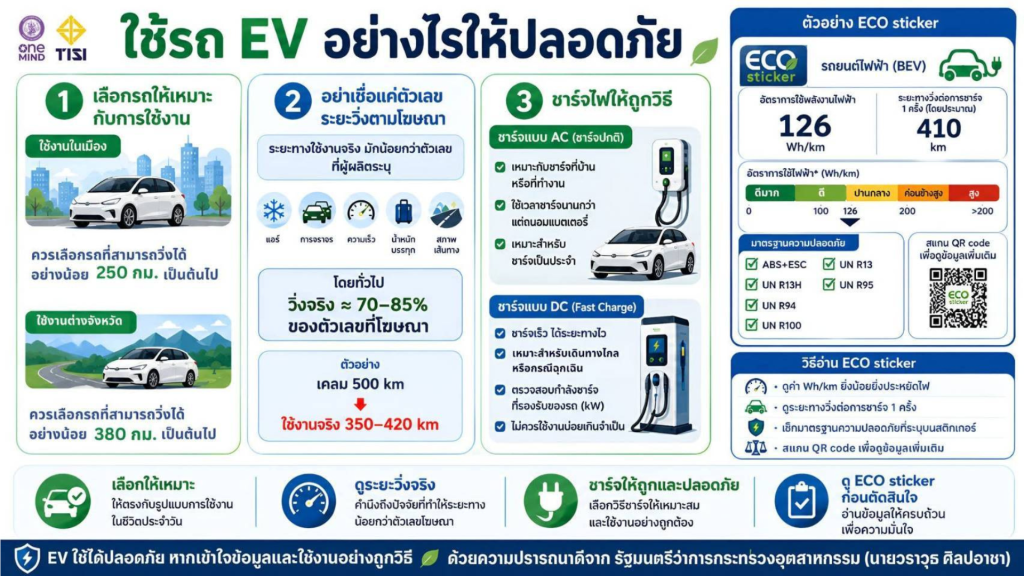
Ministry of Industry: Safe and Energy-Efficient EV Usage Guide
- Select the Right Vehicle for Your Needs
Choose an EV that aligns with your daily driving habits to optimize both safety and energy efficiency
City Commuting: Look for an EV with a driving range of at least 250 km per charge.
Long-Distance/Provincial Travel: Look for an EV with a driving range of at least 380 km per charge. - Understand Advertised vs. Real-World Range
Do not rely solely on advertised figures. In real-world conditions, EVs typically achieve about 70–85% of their advertised range. For example, a vehicle advertised at 500 km per charge may deliver 350–420 km in practice. Actual range varies based on factors such as weather, driving style, road incline, temperature, and battery levels. - Use the Correct Charging Methods
3.1) AC Charging (Normal Charge): Ideal for home or workplace parking. Although it takes longer to charge, it preserves battery health and is highly recommended for daily use.
3.2) DC Charging (Fast Charge): Delivers rapid charging, making it ideal for long-distance travel or emergencies. Avoid overusing fast charging to prevent battery degradation, and always check your vehicle’s maximum supported charging capacity (kW). - How to Read the Eco Sticker
All EVs sold in Thailand must display an Eco Sticker. This label provides standardized international performance and safety data to help consumers compare models before making a purchase. Key information includes:
4.1) Electrical Energy Consumption: Indicated in kilowatt-hours per 100 kilometers (kWh/100 km). The lower the number, the more energy-efficient the car is.
4.2) Maximum Driving Range: The maximum distance the vehicle can travel on a single full charge (km/charge).
4.3) International Safety Standards (UN Regulations): Certification confirming compliance with rigorous electrical, battery, and crash safety standards, specifically UN R100, R94, R95, and R13H.
4.4) Battery Safety Standards: Dedicated certification verifying the safety and stability of the battery system.
4.5) Vehicle and Manufacturer Information: General details including the vehicle model, manufacturer, or importer specifications.